Friday, November 25, 2005

TCRP Report Discusses Carsharing Partnerships


The long awaited report Carsharing: Where and How It Succeeds is now available. It's the product of three years of effort by Adam Millard-Ball and others in the San Francisco office of Nelson\Nygaard Consulting and Jon Burkhardt of Westat in Rockville, MD. The report was commissioned by the Transit Cooperative Resarch Program (TCRP) of the Transportation Research Board (TRB) and funded by the US Department of Transportation.

In talking about potential markets, Millard-Ball makes a useful, and sometimes overlooked, distinction between demographic characteristics and geographic characteristics. The report includes a fascinating sample analysis of the carsharing characteristics of several neighborhoods in Madison, Wisconsin (unfortunately, much abbreviated from the draft version). The report also includes a survey of members from virtually every carshare in the US and several in Canada, providing a good overview of the characteristics, motivation and usage patterns of current members of what I consider the "classic" form of neighborhood and business carsharing.

The report will be appreciated for its detailed and extensive summary of the impacts and benefits of carsharing, gathered from every evaluation I've ever heard of (as well as several I wasn't aware of). There's also an amazing bibliography of documents from Europe and the US.

The report concludes with a discussion of major barriers to the adoption of carsharing by partners. They include:
• Understanding the role of carsharing
• Lack of data to make a decision
• Financial limitations
• Parking issues
• Low income participation
• Geographical and cultural barriers
There's also a discussion of the procedures agencies might use to partner with carsharing companies, including discussion of the RFP and other procurement methods.

In addition to the full report, several short (8 page) descriptions of carsharing partnership have been produced for specific partner groups. These include: local governments, transit agencies, developers, employers and businessesm and universities. These reports will be useful to provide background and "credibility" for the value of such a partnership. (As of when I wrote this, not all Partner reports were actually posted to their website for download.)

The full Nelson\Nygaard report (not including the appendices) are available at the LINK below. See the link on the Linked page for details on how to download the report with appendices

Thursday, November 24, 2005

What can your city do to bring carsharing?

Over the years I’ve talked to many people in local government, transportation advocates and just plain folks who’d like to bring carsharing to their city. You probably can’t do it single-handedly, unless you’re ready to start your own carshare. (And if you are thinking about starting your own carsharing service, I want to talk to you today!)

It would be easy if you could just get Zipcar or Flexcar to set up shop in your city. Right now, they each have their own private shortlist of cities they think are most promising for the next 2-3 years. They’re probably concentrating on cities within the top 25 population in the US. And they're probably also looking at factors such as the following:
• Downtowns that are revitalizing with apartment and condo construction,
• Good mass transit or at least higher than average use of alternate commute modes (walking, cycling, carpooling and public transit),
• Walkable neighborhoods (that means sidewalks!) with local business districts
• And, of course, parking congestion is a good sign for carsharing, too.

The “big guys” of carsharing are naturally going to prioritize their investment and will go where they feel they'll get the warmest welcome. They’re probably looking for places where the city and transit agency want to develop a strong public-private partnership, through programs to jointly market services, to provide free or discounted parking (on-street parking is probably most attractive because of the extra exposure to pedestrians). Such a partnership doesn’t necessarily mean spending any money, but it does mean a commitment from the top levels of government.

Another factor that makes a city attractive is the possibility of offsetting at least part of the city-owned fleet with carsharing vehicles. This gives the carsharing company much-needed revenue while the neighborhood membership and vehicle use grows. Businesses, the larger and more close to downtown the better, willing to shift their fleet expenses to shared vehicles also make it more attractive for carsharing.

What about cities not in the top 25?

Flexcar and Zipcar may eventually consider these cities, as well, but right now they have bigger fish to fry. They're interested in cities that offer the biggest long-term possibilities for expansion - an eventual fleet of 500 is a lot more attractive than one that they think might top out at 100. And I suspect, where you're located in relation to their nearest existing operation also plays a factor, as well.

Howver, Zipcar and Flexcar may still can be willing to set up shop in your town if you’re willing to negotiate a per-vehicle subsidy for a period of time (as well as many of the other things listed above that you can bring to the table). Look at Zipcar's operation in Chapel Hill, North Carolina. College and university towns may be particularly attractive in this regard, since there's likely to be a big base of prospecttive customers that would likely be receptive to the idea of carsharing.

Cultivating a local entrepreneur is another way to bring carsharing. Of course, the hometown company will benefit from the same incentives (described above) that the national companies would. One thing to pay particular attention to with local start up is that they have the ability, or at least a viable business plan, to be able to expand to provide the size service you’d like to see. A non-profit that peaks at 10 or even 40 cars probably isn’t going to make much of a dent in the problems you’d like to address.

In a future post I'll discuss some steps a local government can take to get carsharing started.

Friday, November 18, 2005

Vehicle Selection


One of the first decisions a carshare faces is "what kind(s) of cars should we have?" It's one of those tantalizing questions that provokes endless discussion as we try to fathom the mind of our members and run an efficient operation. Should we have dazzling variety of vehicles like Zipcar, or a familiar few quality models, like Flexcar, or something in between?

So far most US carshares have stuck mostly with reliable Japanese vehicles, which are presumably also popular with their prospective customers. As appealing as VWs and BMWs may be, their reliability stinks. And nobody wants an irate call from a member in the middle of a trip. City Carshare and Zipcar, which both used the green VW Beetles as their signature car when they started (and got into a spat about it), have gotten rid of almost all of them.

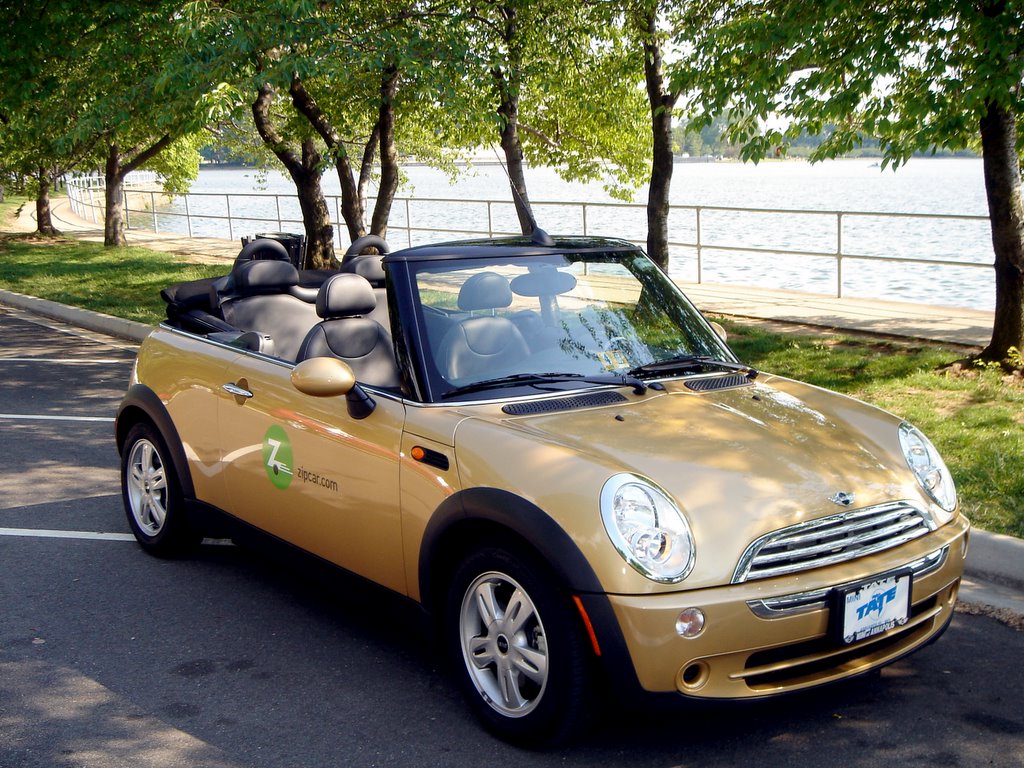
But Zipcar has shown, and Toronto Autoshare and even Mobility Carsharing Switzerland can confirm, there's a market for and good profit in having a few upscale cars in the fleet, as well. The Swiss call them "fashion" cars! Zipcar's pricing shows they command a premium - $16/hour on weekends for a Mini convertible or Volvo V50, compared to $14/hour on weekdays - in an admittedly "premium" city!

In an earlier post, I wrote about the major factor determining the monthly lease cost was the Residual Value. One good, quick source of information is Intellichoice's Top 10 Best in Class listings . So which vehicles hold their value best?

Here's Intellichoice's Lowest Depreciation Compact cars:
Chevy Cavalier with Option package SV1
Ford Focus 3 door
Honda Civic
Hyundai Accent
Hyundai Elantra
Nissan Sentra
Pontiac Sunfire with option group 1-SV
Saturn ION 1
Toyota Echo
Toyota Corolla
VW Golf (including diesel)
VW Jetta (including diesel)

The Toyota Prius doesn't appear on this list because it's technically an "intermediate" sized vehicle. It does appear on the Intellichoice lowest depreciation list in that category - along with Honda Accord, Hyundai Sonata, Mazda 6, Nissan Altima, Suzuki Verona, Toyota Camry and VW Passat. It appears that some of models on this list have low depreciation not because they hold their value well but because the sale price was highly discounted to begin with. Either way, it may work to your advantage.

And since small station wagons are coming back into fashion again, here's list of Lowest Depreciation in the Small Wagon category:
Toyota Matrix 4 Dr Wagon
Kia Rio Cinco Auto 4 Dr Wagon
Kia Rio Cinco 4 Dr Wagon
Scion xB 4 Dr Wagon
Subaru Impreza 2.5 TS Sport Wagon 4 Dr Wagon
Toyota Matrix 4WD 4 Dr Wagon
Volkswagen Jetta GL 4 Dr Wagon

Many US carshares feature Toyota Matrix small station wagon, presumably because the residual values used in calculating leases for the Toyota are higher. But the Suzuki Aerio is another vehicle that the marketplace may not give full credit to. Toronto Autoshare has a substantial number of Suzuki Aerios and reports they are very popular with members. The Aerio costs significantly less than the Toyota Matrix, which it resembles, and has very good reliability ratings in Consumer Reports.

One of the real surprises recently in the automotive field has been the turn-around of Hyundai, which also owns Kia. After years as a low-cost, low-quality carmakers they've transformed themselves into a "Japanese-quality" car brand offering the best warranty in the industry. This year Hyundai dominates the Lowest Repair category and they're also starting to show up in the Intellichoice's Lowest Depreciation lists in their classes as well. As attractive in size and versatility the Kia Spectra 5 or Hyundai Elantra may be, its depreciation rates haven't caught up with apparent quality and so it still may not be an attractive choice for a car share.

So what's the answer - lots of variety or a few "tried and true" models? Take your pick - it defines the kind of carshare you are! But if you're going to do a variety of vehicles it helps to have a well-developed network of vehicles so members can enjoy the variety of cars you offer.

Friday, November 11, 2005

Vehicle Leasing Basics


Carshares can get their vehicles from a variety of sources: they may lease new vehicles, lease or buy used vehicles purchased at wholesale auto auctions. The latter could be a very attractive option if the carshare is willing to invest the additional time needed for this process. I have written earlier about novel ideas for alternate leasing strategies. No carshare is big enough, yet, to get the special "program car" deals that rental car companies get buying directly from manufacturers, perhaps because carshares typically keep their cars in service longer than rental car companies.

When you lease vehicles you soon discover that the major determinant of what your monthly lease cost will be is the Residual Value used to calculate the lease. That's how much the you or the leasing company expects to be able to sell the vehicle for at the end of the lease. Manufacturer consumer leases are able to offer low monthly payment because they've arbitrarily chosen a very high residual (and are prepared to eat the difference at the end of the lease, in order to move cars off the dealers' lots today). Unfortunately, these leases prohibit the commercial use of leased vehicles so carshares must navigate the commercial lease market - with higher interest rates and realistic residual values.

The other major factor in lease costs is the type of the lease - Closed-end or Open-end. With a Closed-End lease, if you return the vehicle in satisfactory condition (satisfactory as described in the terms of the lease), the leasing company accepts the risk that they can get their calculated Residual Value and you're done with it. With an Open-End lease, you're agreeing to share the risk that the residual used is a fair one and that the vehicle will net that amount. There are plenty of web sites that will tell you more than you want to know about leasing. Automotive Lease Guide has an excellent Leasing 101 tutorial.

The web is a great source of information about cars. Several websites that can help you manage your fleet more efffectively are: Intellichoice for information about the cost of ownership for new vehicles; Edmunds .
for information about the value of used cars; and Fleet Central . for information about the entire range of fleet management issues. Fleet Central is the web presence of Bobit Publications, the major trade publisher for various fleets - government, business, rental car, remarketing, etc. Another helpful website for larger carshares is the Automotive Lease guide - a data service that tracks wholesale prices of vehicles around the country.

Remarketing of vehicles at the end of their lease or service in your fleet is a major topic itself and is covered in the fleet magazines. Rental car companies for years have been managing their fleets and maximizing their profits from resales by carefully tracking the wholesale values of used cars at auto auctions using services such as the Automotive Lease Guide.

For smaller carshares selling their vehicles at the end of the lease, Edmunds does a good job showing you what you can hope to get if you're selling a used vehicle, showing expected Trade In Value, Private Party Sale and Dealer Retail prices, supposedly adjusted by region. Edmunds also has a database showing the cost of manufacturer's suggested maintenance procedures.

Saturday, November 05, 2005

Higher Gas Prices Spur Carsharing Membership

All the carshares I've talked to have been reporting very strong membership growth during 2005. Zipcar CEO, Scott Griffith, reports that they're taking in 3,000 new members per month (in all cities), and have experienced a 30% increase in signups since August, when gas prices started to climb, according to a recent Boston Herald article.

Higher gas prices certainly help draw a car owner's attention to the possibility of alternatives, including carsharing, for at least some of their trips. Marketing by carshares emphasizing "free gas" certainly takes advantage of this new awareness. Here's an ad appearing on buses in Seattle that includes Flexcar as one of the alternatives.


A recent study by GfK NOP, an international consulting firm specializing in consumer research (GfK stands for Growth from Knowledge), identifies the price thresholds at which Americans say they will alter their lifestyles to save on gas, including carpooling; using public transportation; walking, biking or using other forms of transportation; reducing overall driving, using their most fuel efficient vehicle; and buying a more fuel efficient vehicle.

The GfK NOP Green Guage study, based on in-home interviews with 2000 people, reports that 25% of people surveyed would consider alternatives at $3 per gallon. We're there in many parts of the country and apparently they are considering alternatives.

Lifestyle changes consumers will make based on the price per gallon of gas
(from GfK NOP 2005 Green Gauge Report)


                             $3.00/   $3.50/   $4.00/   $5.00+/
gal gal gal gal
Drive Your Most Fuel
Efficient Vehicle 35% 44% 50% 57%
Immediately Purchase a
More Fuel Efficient
Vehicle 27% 40% 54% 71%
Reduce Overall Driving 34% 47% 56% 65%
Walk/Bike More and Other
Forms of Transportation 24% 38% 49% 64%
Use Public Transportation 16% 26% 40% 59%
Carpool 25% 38% 49% 66%

Based on the Percentage of Consumers Owning at Least One Vehicle
Numbers are Cumulative


Below is a link to the GfK NOP press release about the study.